Tuesday, December 4, 2007

Mafia boss arrested while watching Mafia TV show

PALERMO, Italy (Reuters) - Italian police burst into the room of a suspected Mafia mobster in Sicily and arrested him as he watched a television show about the arrest of a Mafia boss, investigators said Friday.
Police said Michele Catalano was watching the concluding chapter late Thursday of the TV mini-series "The Boss of Bosses," recounting the arrest in 1993 of real-life Cosa Nostra leader Salvatore "Toto" Riina, when he was detained.
They Catalano, 48, was suspected of being a senior commander serving under the latest "boss of bosses" Salvatore Lo Piccolo, who was arrested this month after nearly 25 years on the run.
Catalano faces charges of drug trafficking and extortion.
Lo Piccolo had taken over the reins of the Sicilian crime syndicate from Riina's successor Bernardo Provenzano, who was arrested last year after 40 years on the run. The arrests have seriously weakened the Mafia, police say.
Politicians and cultural figures criticized Channel 5's mini-series for portraying Riina as a hero and lobbied its owner Mediaset, belonging to former prime minister Silvio Berlusconi, to take the final episode off the air. Mediaset declined.
Nicknamed "the Beast" for his brutality, Riina has been convicted on more than 100 counts of murder.

Santa Claus is coming to town -- for 34 microseconds

STOCKHOLM (AFP) - Christmas is hectic for all but particularly for Santa, who must live in Kyrgyzstan and make his rounds at lightning speed if he is to deliver gifts to all the world's children on time, a Swedish consultancy has concluded.
Between Christmas Eve and Christmas Day, Santa Claus's route around the planet includes stops at 2.5 billion homes, assuming that children of all religions receive a present from the jolly man in the red suit, Anders Larsson of the engineering consultancy Sweco told AFP.
"We estimated that there are 48 people per square kilometer (120 per square mile) on Earth, and 20 metres (66 feet) between each home. So if Santa leaves from Kyrgyzstan and travels against the Earth's rotation he has 48 hours to deliver all the presents," he said.
Father Christmas has long been believed to reside at the North Pole, although a number of northern towns, including Finnish Rovaniemi, claim to be his true home.
But Sweco's report on Santa's most efficient route -- which takes into account factors like geographic density and the fewest detours -- shows that he wouldn't be able to make his round-the-world trip from there in time.
"He has 34 microseconds at each stop" to slide down the chimney, drop off the presents, nibble on his cookies and milk and hop back on his sleigh, Larsson said.
Santa's reindeer must travel at a speed of 5,800 kilometers (3,604 miles) per second to make the trip on time.
Another report circulating on the Internet suggested however that Santa's sleigh, weighed down with presents and travelling at supersonic speed, would encounter such massive air resistance that the entire contraption would burst into flames and be vaporised within 4.26 thousandths of a second.

Miss China on top of the world

SANYA, China (AFP) - Pre-contest favourite Miss China won the Miss World 2007 title in her own country late Saturday, much to the delight of the audience, in front of an estimated two billion viewers around the globe.
Twenty-three-year-old Zhang Zilin was crowned the winner in Sanya, China. Miss Angola came second and Miss Mexico third at the beauty pageant, held on the southern holiday island of Hainan, dubbed China's answer to Hawaii.
Viewers in 200 countries were expected to tune in to watch the show, which saw Miss China take the crown ahead of 105 of the world's most beautiful and talented women.
The audience in the 2,000-capacity Beauty Crown Theatre, specially built for when Sanya first hosted the event in 2003, roared in delight as Zhang was crowned the winner at the end of the two-hour-long contest, which was conducted mainly in English.
The secretary from Beijing was the pre-contest favourite with British bookmakers, along with Miss Dominican Republic.
At 182 centimetres (six feet), Zhang was also the tallest contestant.
"There are 1.3 billion people behind me," she said during the interview stage of the contest, referring to China's population.
"If I win I want to become a link between the Olympic Games (in Beijing next year) and the Miss World Organisation."
"I want to use the power and beauty of Miss World to support those in need," she said, speaking throughout in hesitant English, adding a few words in Chinese.
Zhang earlier told the contest her favourite pasttimes were the 100-metre hurdles and the high jump.
Fireworks exploded above the crown-shaped theatre, where visitors had paid up to 300 dollars for tickets, after the popular decision was made.
Miss Mexico had also been strongly fancied, while Miss Angola was an outsider.
"I want to tell you that I am a strong woman and also a dreamer girl and I don't accept failures in my life," Carolina Moran Gordillo, Miss Mexico, said earlier in the contest.
"This is my dream and I worked very very hard to get here," the 19-year-old student added.
Portuguese-born Miss Angola, Micaela Reis, 18, said she wanted to win the coveted crown so she could spread awareness about AIDS/HIV.
Contestants were rated on an array of disciplines including physical fitness, style, dress, personality and beauty.
The 106 were whittled down to 16, then five, with hotly tipped Miss Dominican Republic not making the final five despite strong support from the mainly Chinese crowd.
The 57th edition of the contest was being held on World AIDS Day as organisers wanted the annual showcase of gloss and glitz, seen by critics as a sexist throwback, to help increase awareness of the fight against HIV/AIDS.
To underline their commitment to AIDS awareness, organisers invited former South African president Nelson Mandela's eldest daughter Maki to serve on the panel of nine judges.
The Noble laureate's son Makgatho died of an AIDS-related illness in 2005, and the family has since been active in the global fight against HIV/AIDS.
As well as being held on World AIDS Day, Miss World 2007 came a week after Chinese state media reported hotels in Beijing have been ordered to stock condoms in every room in response to a spike in new HIV infections in the capital.

British teacher arrives home from Sudan


LONDON - A British teacher jailed in Sudan for letting her students name a teddy bear Muhammad as part of a writing project arrived home Tuesday after being pardoned and said she was "very upset to think that I might have caused offense to people."
Gillian Gibbons told reporters after arriving at London's Heathrow Airport that she was looking forward to seeing her family and friends.
"I'm just an ordinary middle-aged primary school teacher. I went out there to have an adventure, and got a bit more than I bargained for," Gibbons said at a brief news conference.
"I don't think anyone could have imagined it would snowball like this," she added.
Gibbons, 54, jailed for more than a week, was freed after two Muslim members of Britain's House of Lords met with Sudanese President Omar al-Bashir and the teacher sent the president a statement saying she didn't mean to offend anyone with her class project.
"It has been an ordeal but I'd like want you to know that I was well-treated in prison and everybody was very kind to me," she said. "I was very sorry to leave Sudan. I had a fabulous time there. It's a really lovely place, and I managed to see some of the beautiful countryside while I was there."
Gibbons said she didn't want her experience "to put anyone off going to Sudan — in fact I know of a lovely school that needs a new Year Two teacher."
The incident was the latest in a tense relationship between the West and Sudan's president, an Islamic hard-liner who has been accused by the United Nations of dragging his feet on the deployment of peacekeepers to the country's war-torn Darfur region.
Al-Bashir insisted Gibbons had a fair trial, in which she was convicted of insulting Islam's Prophet Muhammad, but the president agreed to pardon her during the meeting with the British delegation, said Ghazi Saladdin, a senior presidential adviser.
Gibbons left Sudan Monday night, flying via Dubai to London.
"I'd like to thank the government for all they have done, the hard work behind the scenes, especially the two peers who went out there," said her 25-year-old son, John. "Everyone's been really great."
When asked her feelings about the offense she was accused of, Gibbons said: "I don't think I really know enough about it to comment really. It's a very difficult area and a very delicate area."
"I was very upset to think that I might have caused offense to people," she added.
Gibbons said she learned of the intense media coverage of the story on her second day in prison.
Asked if she was terrified of prison, she said: "That's an understatement."
"I was treated the same as any other Sudanese prisoner in that you were given the bare minimum," she said. "Then I was moved to another prison and there the Ministry of the Interior sent me a bed which is possibly the best present I've ever had."
What Britain and Gibbons' supporters said was a misunderstanding over the teddy bear escalated into a diplomatic flap between London and Khartoum — and the show of outrage in Sudan that puzzled many in the West.
Hard-line Muslim clerics in Sudan denounced Gibbons, saying she intentionally aimed to insult Islam. A day after her Thursday trial, several thousand Sudanese massed in central Khartoum to demand that Gibbons be executed. Many of the demonstrators carried swords and clubs.
But it was never clear how deep anger over the incident really flowed among Sudanese, although the affair was influenced by the ideology that al-Bashir's Islamic regime has long instilled — a mix of anti-colonialism, religious fundamentalism and a sense that the West is besieging Islam.
"Common sense has prevailed," British Prime Minister Gordon Brown said in a statement expressing delight over Gibbons' release.
British Foreign Secretary David Miliband praised Gibbons, saying that "she's shown very good British grit in very difficult circumstances."
Gibbons, who was arrested Nov. 25, was sentenced to 15 days in prison and deportation under Sudan's Islamic Sharia law for having the teddy bear project for her class of 7-year-olds at the private Unity High School. She could have been punished with up to 40 lashes, six months in prison and a fine.
In the project, she had a student bring in a teddy bear, then asked her pupils to vote on a name for it. They chose Muhammad, a common name among Muslim men. The students took the bear home individually to write diary entries on it, which were then compiled into a book with the bear's picture on it and the title "My Name is Muhammad," school officials said.
Gibbons' defenders said the project was a common one in British schools.
The trial was sparked when a school secretary complained to the Education Ministry that Gibbons aimed to insult Islam's prophet.
The private English-language school, with elementary to high school levels, was founded by Christian groups, but 90 percent of its students are Muslim, mostly from upper-class Sudanese families.
Lord Nazir Ahmed, part of the British delegation that met with al-Bashir, said the case was an "unfortunate misunderstanding" and stressed that Britain respected Islam. He added that he hoped "the relations between our two countries will not be damaged by this incident."
Many Muslim groups in the West had sharply criticized Gibbons' arrest. On Monday, Inayat Bunglawala, a spokesman for the Muslim Council of Britain, welcomed her pardon.
"Gillian should never have been arrested in the first place, let alone held in jail. She had done nothing wrong," he said. "It will be wonderful to see her back in the U.K. I am sure she will be welcomed by both Muslims and non-Muslims after her quite terrible ordeal at the hands of the Sudanese authorities."
Muslim scholars generally agree that intent is a key factor in determining if someone has violated Islamic rules against insulting the prophet.
But hard-liners in Sudan touted the incident as part of a Western plot to undermine Islam, echoing accusations from controversy raised early in the year by the publication of cartoon caricatures of the prophet in European newspapers.
Al-Bashir's opponents in Sudan have said his government likely let the Gibbons case move forward to stir up anti-Western anger at a time when he is resisting allowing Western peacekeepers in the Darfur peacekeeping force. He has said he will bar any Scandinavians from the force since newspapers in their countries ran the prophet cartoons.
___
Associated Press Writer Alfred de Montesquiou in Khartoum, Sudan contributed to this report.

Thursday, November 29, 2007

Mother Teresa Biography

Born: August 27, 1910
Died: September 5, 1997

Achievements: Started Missionaries of Charity in 1950; received Nobel Prize for Peace in 1979; received Bharat Ratna in 1980.
Mother Teresa was one of the great servants of humanity.
She was an Albanian Catholic nun who came to India and founded the Missionaries of Charity in Kolkata. Her selfless work among the poverty-stricken people of Kolkata (Calcutta) is an inspiration for people all over the world and she was honored with Nobel Prize for her work. Mother Teresa's original name was Agnes Gonxha Bojaxhiu.
She was born on August 27, 1910 in Skopje, Macedonia. Her father was a successful merchant and she was youngest of the three siblings. At the age of 12, she decided that she wanted to be a missionary and spread the love of Christ. At the age of 18 she left her parental home in Skopje and joined the Sisters of Loreto, an Irish community of nuns with missions in India. After a few months of training at the Institute of the Blessed Virgin Mary in Dublin Mother
Teresa came to India. On May 24, 1931, she took her initial vows as a nun. From 1931 to 1948, Mother Teresa taught geography and catechism at St. Mary's High School in Calcutta. However, the prevailing poverty in Calcutta had a deep impact on Mother Teresa's mind and in 1948, she received permission from her superiors to leave the convent school and devote herself to working among the poorest of the poor in the slums of Calcutta.After a short course with the Medical Mission Sisters in Patna, she returned to Calcutta and found temporary lodging with the Little Sisters of the Poor. She started an open-air school for homeless children. Soon she was joined by voluntary helpers, and she received financial support from church organizations and the municipal authorities. On October 7, 1950, Mother Teresa received permission from the Vatican to start her own order. Vatican originally labeled the order as the Diocesan Congregation of the Calcutta Diocese, and it later came to known as the "Missionaries of Charity".
The primary task of the Missionaries of Charity was to take care of those persons who nobody was prepared to look after.The Missionaries of Charity, which began as a small Order with 12 members in Calcutta, today has more than 4,000 nuns running orphanages, AIDS hospices, charity centres worldwide, and caring for refugees, the blind, disabled, aged, alcoholics, the poor and homeless and victims of floods, epidemics and famine in Asia, Africa, Latin America, North America, Poland, and Australia. In 1965, by granting a Decree of Praise, Pope Paul VI granted Mother Teresa permission to expand her order to other countries. The order's first house outside India was in Venezuela. Presently, the "Missionaries of Charity" has presence in more than 100 countries.Mother Teresa's work has been recognised and acclaimed throughout the world and she has received a number of awards and distinctions. These include the Pope John XXIII Peace Prize (1971), Nehru Prize for Promotion of International Peace & Understanding (1972), Balzan Prize (1978), Nobel Peace Prize (1979) and Bharat Ratna (1980).On March 13, 1997, Mother Teresa stepped down from the head of Missionaries of Charity and died on September 5, 1997, just 9 days after her 87th birthday.
Following Mother Teresa's death, the Holy See began the process of beatification, the second step towards possible canonization, or sainthood.
This process requires the documentation of a miracle performed from the intercession of Mother Teresa. In 2002, the Vatican recognized as a miracle the healing of a tumor in the abdomen of an Indian woman, Monica Besra, following the application of a locket containing Teresa's picture. Monica Besra said that a beam of light emanated from the picture, curing the cancerous tumor. Mother Teresa was formally beatified by Pope John Paul II on October 19, 2003 with the title Blessed Teresa of Calcutta. A second miracle is required for her to proceed to canonization.

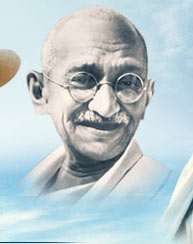
Mahatma Gandhi Quote

Here are some famous quotes by Mahatma Gandhi. These quotes reveal his thinking and are a guiding light and source of inspiration to others.

  • I will give you a talisman. Whenever you are in doubt, or when the self becomes too much with you, apply the following test. Recall the face of the poorest and the weakest man [woman] whom you may have seen, and ask yourself, if the step you contemplate is going to be of any use to him [her]. Will he [she] gain anything by it? Will it restore him [her] to a control over his [her] own life and destiny? In other words, will it lead to swaraj [freedom] for the hungry and spiritually starving millions? Then you will find your doubts and your self melt away.
  • Abstinence is forgiveness only when there is power to punish; it is meaningless when it pretends to proceed from a helpless creature.
    Action for one's own self binds, action for the sake of others delivers from bondage.

  • What is faith worth if it is not translated into action?
    You assist an administration most effectively by obeying its orders and decrees. An evil administration never deserves such allegiance.
    Ahimsa is the highest ideal. It is meant for the brave, never for the cowardly.

  • Ahimsa is the eradication of the desire to injure or to kill.

  • Ahimsa is an attribute of the brave. Cowardice and ahimsa don't go together any more that water and fire.
    True ahimsa should mean a complete freedom from ill-will and anger and hate and an overflowing love for all.
  • The removal of untouchability is one of the highest expressions of ahimsa.
  • The strength to kill is not essential for self-defence; one ought to have the strength to die.
  • Khadi has been conceived as the foundation and the image of ahimsa. A real khadi-wearer will not utter an untruth. A real khadi-wearer will harbour no violence, no deceit, no impurity.
  • No power on earth can subjugate you when you are armed with the sword of ahimsa. It ennobles both the victor and the vanquished.
  • The votary of ahimsa has only one fear, that is, of God.
  • The hardest heart and the grossest ignorance must disappear before the rising sun of suffering without anger and without malice.
    The power of unarmed nonviolence is any day far superior to that of armed force.
  • I know nothing of the science of astrology and I consider it to be a science, if it is a science, of doubtful value, to be severely left alone by those who have any faith in Providence.
  • God is conscience. He is even the atheism of the atheist.

Facts About Mahatma Gandhi

Here is a brief summary of some of the major facts associated with Mahatma Gandhi. These facts highlight some of the major achievements of Mohandas Gandhi and provide valuable information on Mahatama Gandhi.
Birth: October 2, 1869
Death: January 30, 1948
Place of Birth: Porbandar, Gujarat
Father: Karamchand Gandhi
Mother: Putlibai
Wife: Katurbai
1888-1891: Studied law in London
1893: Sailed for South Africa
1906: Began Satyagraha campaign in South Africa to protest the requirement that Indians be fingerprinted and carry identification cards
1915: Returned to India from South Africa
1917: Initiated Champaran Satyagraha to alleviate the condition of indigo planters
1919: Instituted Satyagraha campaign in India to protest the Rowlatt Acts, which deprived all Indians of important civil liberties.
1922: Ended Non-Cooperation movement against British Raj after his followers were involved in a series of riots and disturbances that violated his policy of nonviolence
1930: Led Dandi March to collect salt in protest of the British salt tax.
1931: Signed a pact with Lord Irwin to suspend the Civil Disobedience Movement and went to London to attend Round Table Conference.
1932: Fasted to protest the treatment of people who belonged to no Hindu caste, the Harijans or Untouchables
1942: Launched Quit India Movement against British Raj.
January 30, 1948: Assassinated by Nathuram Godse, a Hindu extremist.